
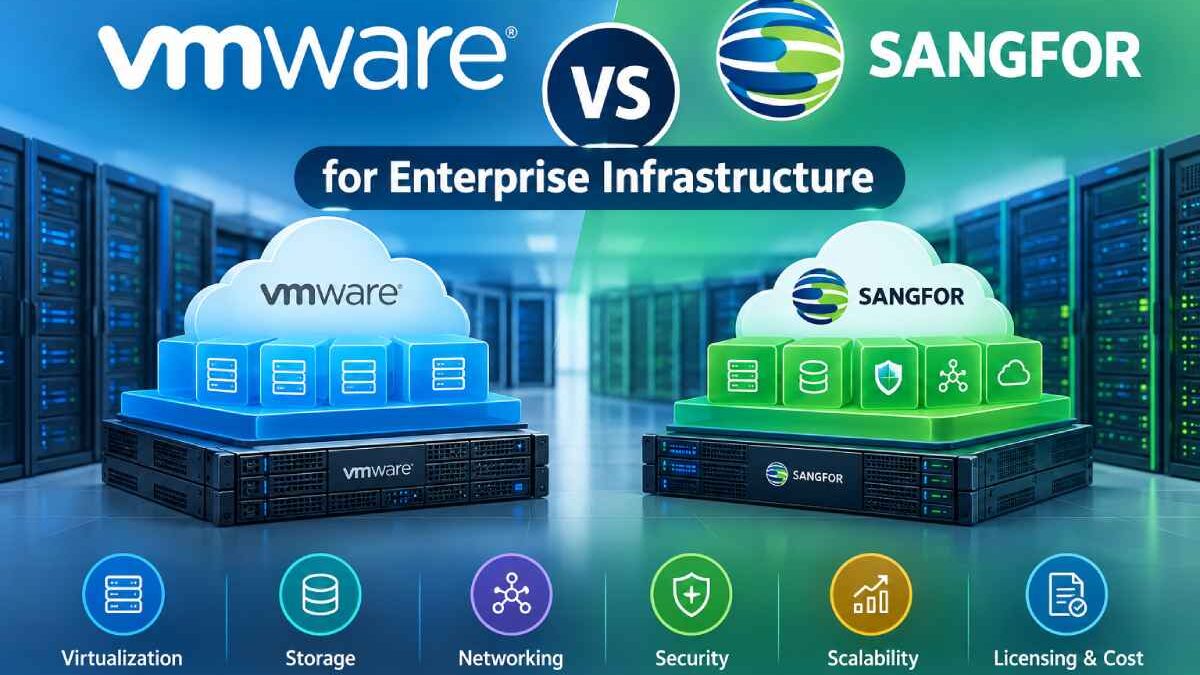
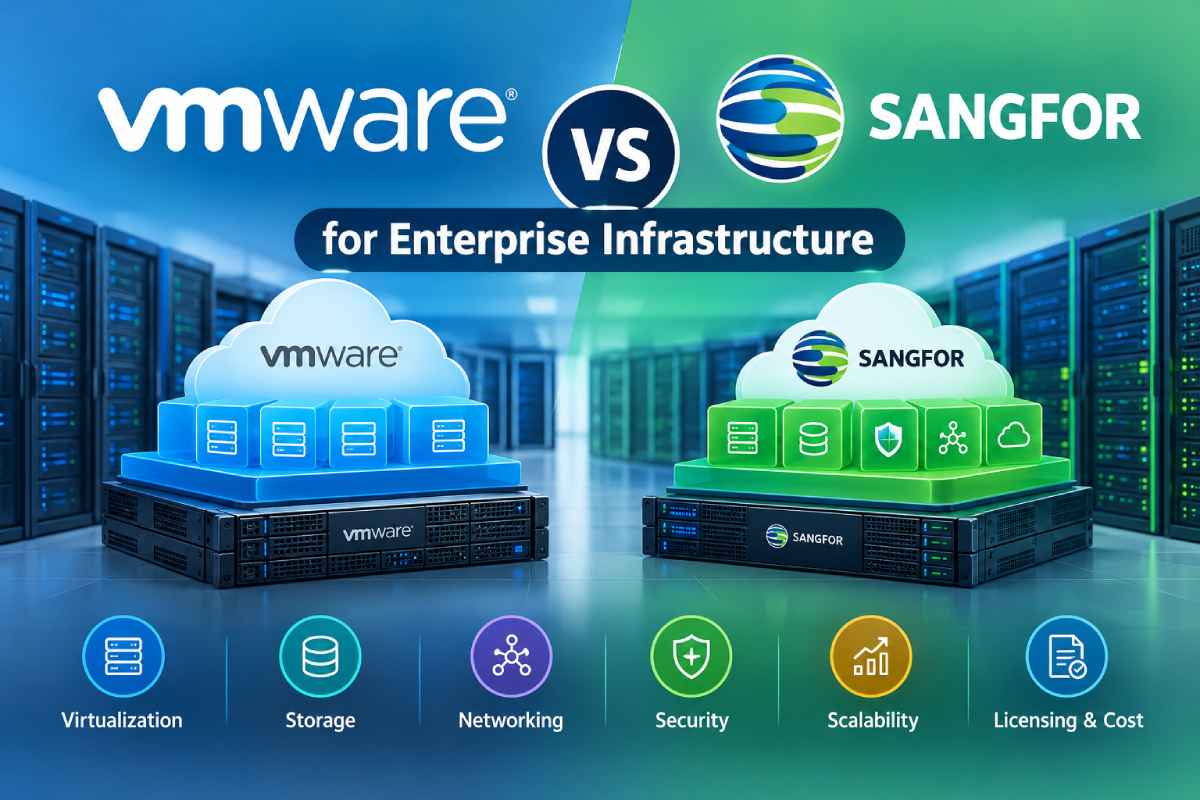
Ask a room of infrastructure leads about VMware today and the conversation usually lands on one thing: the bill. Since Broadcom moved VMware to subscription-only, bundled licensing, many CTOs have started putting it side by side with full-stack hyperconverged platforms. That is why VMware vs Sangfor comes up far more often than it used to.
But this calls for a balanced comparison, with VMware remaining the benchmark for virtualization. While it remains the right choice for many, in a broader context, brands like Sangfor are making a hard-to-ignore case.
Table of Contents
VMware vs Sangfor Quick Comparison Summary
Let’s start this VMware vs Sangfor HCI conversation with a quick comparison summary of the platforms. Let’s see how each brand stacks up on several fronts.
| Dimension | VMware | Sangfor HCI |
| Architecture | Modular stack built around vSphere, vSAN, and NSX | Virtualization, storage, networking and security presented as one platform |
| Licensing | Subscription-only, sold in bundles that vary by edition | Socket-based licensing with a perpetual option, per published customer cases |
| Availability and DR | Delivered through VMware products and a broad partner ecosystem | HA and disaster recovery management in the platform, with Veeam and Cohesity for backup |
| Security | NSX and partner tooling, depending on the bundle | Micro-segmentation through aNET, further controls through components such as aSEC |
| Management | vCenter-centered, with a mature operations ecosystem | Sangfor Cloud Platform console, designed to feel familiar to VMware teams |
| Scalability | Wide scale range, hardware governed by VMware’s compatibility lists | Scales by adding nodes, hardware checked against Sangfor’s compatibility chart |
| Best fit | Deep existing investment, broad third-party ecosystem, certified integrations | Full-stack simplicity, predictable licensing, built-in resilience for mid-market to large enterprises |
What is the main difference between VMware and Sangfor HCI?
The main difference is scope and integration. VMware offers a broad, modular stack of vSphere, vSAN, and NSX, assembled according to the bundle you buy. Sangfor HCI presents virtualization, storage, networking, and security as one platform. The right choice depends on existing investment, ecosystem needs, and how much simplicity matters to your team.
VMware vs Sangfor Architecture and Platform Scope
The first point of comparison between the two brands is their architecture and platform scope. VMware’s stack spans:
- vSphere for virtualization
- vSAN for storage
- NSX for networking
Other components are layered on top. This breadth is VMware’s real strength, but it also means that, depending on the bundle you choose, a company may work with several products. Licenses and integration points to assemble a complete platform.
Sangfor HCI, on the other hand, takes the converged route. Here is how:
- The hypervisor, aSV, handles virtualization
- aSAN provides distributed storage
- aNET covers network virtualization
- aSEC adds security
The Sangfor Cloud Platform sits above them as the management layer. Sangfor Cloud Platform (SCP) sits above them as the management layer, comparable in role to VMware vCenter Server, although the two differ in scope, ecosystem and operational model.
That said, one detail needs closer examination, especially for phased projects. Sangfor also offers aSV as a standalone hypervisor, comparable to VMware ESXi, so teams can migrate compute first and decide later whether to adopt the full HCI stack. That suits teams who want to stage the change.
VMware vs Sangfor Licensing and Cost Considerations
VMware licensing is the primary reason most of these evaluations began. After Broadcom’s acquisition, the company moved to subscription-only licensing and bundled its products. For some customers, that simplifies buying; for others, it means paying for components they didn’t choose. However, the bundle contents and minimums change, so check Broadcom’s current documentation before modeling any cost.
Sangfor’s approach differs in structure. The company uses socket-based licensing with a perpetual option, and Sangfor HCI includes aSAN distributed storage and aNET networking as integrated components of the platform, with socket-based licensing and a perpetual option available. Licensing terms vary by region and configuration, so confirm the exact scope with your Sangfor representative. Additionally, the pricing still depends on configuration, support level, and region, so treat any vendor’s headline numbers with caution.
The cost aspect here is rarely about the license alone. Hardware refresh cycles, backup tooling, staff skills, and the effort of moving everything all factor into the total. So, ask each vendor for a multi-year quote for the same workload, then compare them like-for-like to decide.
Is Sangfor HCI a good replacement for VMware?
For many enterprises, yes, especially those that prioritize full-stack simplicity, predictable licensing, and built-in resilience. Sangfor HCI is designed to feel familiar to VMware administrators and includes assessment and conversion tools. It is less suited for environments where applications are certified only on VMware or where deep third-party integrations cannot be replaced.
VMware vs Sangfor Availability, Disaster Recovery, and Backup
VMware offers disaster recovery and backup through its own products and a deep partner ecosystem. Also, it proves highly effective for most enterprises, as they run it successfully. The difference, however, lies in the integration model: you assemble it from parts on one side and build it on the other.
Sangfor includes high availability and disaster recovery management in the platform itself. For backup, recovery and DR orchestration, Sangfor works with Veeam, providing agentless VM protection. Teams leaving VMware can often continue using their existing Veeam workflows, and retention of existing backup files depends on version and configuration, so validate restores on the target platform.
Sangfor also has a global strategic partnership with Cohesity, which, following its merger with Veritas, supports data resilience, management and security. This matters to organizations that have standardized on Cohesity for data protection.
VMware vs Sangfor Security Capabilities
The VMware vs Sangfor security discussion must be based on their integration model. Here, VMware offers network and security capabilities through NSX and another partner ecosystem. However, depending on the edition, customers can license and operate these components separately.
Sangfor, by contrast, builds most of its security layer into the platform. aNET supports micro-segmentation, and additional controls come through components such as aSEC. Some capabilities are native, but others require a separate Sangfor product. That’s why you must ask for a clear map before signing anything.
Infrastructure choices also shape how security work gets done. If your team is still deciding how much to build in-house, the SecOps maturity model is a practical way to find where you stand before adding tools.
How does licensing compare between VMware and Sangfor HCI?
VMware moved to subscription-only licensing sold in bundles, so cost depends on the edition and components included. Published Sangfor cases describe socket-based licensing with a perpetual option, with storage and networking presented as native to the platform. Final pricing varies by configuration, so request comparable multi-year quotes from both vendors.
VMware vs Sangfor Management and Day-to-Day Operations
Day-to-day operations decide whether a platform is liked or merely tolerated. VMware’s operations ecosystem is mature, and administrators with a decade in vCenter know exactly where everything lives.
In contrast, Sangfor’s Cloud Platform offers a more cohesive experience. It lets you manage compute, storage, networking, and security from a single console. Also, it is designed to feel familiar to VMware teams, which shortens the learning curve. Sangfor also targets multi-site operations, so ask how far central management reaches your own sites because familiar is not identical, and budget time for training, runbook rewrites, and any automation built around VMware tooling.
VMware vs Sangfor Scalability, Hardware, and Multi-Site Deployments
Scalability often becomes the issue nobody worries about until workloads begin to grow. VMware scales across a wide range of deployments, and its hardware compatibility lists are well-known, so verify current support before moving ahead.
Alternatively, Sangfor HCI scales by adding nodes to a cluster and publishing a hardware compatibility chart. So, teams can check existing servers before assuming they carry over. Also, limits depend on version and configuration, which is why you must request the numbers for your own design rather than relying on a headline claim. For multi-site estates, ask how clusters, DR sites, and central management fit together.
The growth plans also deserve a hard look here. If GPU-backed or data-heavy AI workloads are on the roadmap, you must ask each vendor how those nodes are added, licensed and managed alongside existing clusters.
VMware vs Sangfor Migration Path and Ecosystem
A migration plan separates a smooth transition from an expensive lesson. The usual path has four stages:
- Assessment
- Tooling
- Phased cutover
- Rollback
For the assessment stage, Sangfor offers a Migration Assessment Tool that checks compatibility, workload dependencies, and risk before anything moves. Conversion follows with the Sangfor Cloud Migration Tool, which Sangfor says automates VM conversion, configuration mapping and security policy transfer.
Cutover here works best in waves; lower-risk workloads first, with rollback kept live until each wave has run cleanly in production. You can also review Sangfor’s VMware Migration guide for more detail on limiting downtime during transfers.
However, you must check the ecosystem before committing because surprises tend to hide in backup, monitoring, and certified integrations.
Can VMware workloads be migrated to Sangfor HCI?
Yes. Sangfor provides a Migration Assessment Tool to check compatibility and dependencies, and a Cloud Migration Tool that automates VM conversion and configuration mapping. A typical plan covers assessment, tooling, phased cutover in waves, and rollback options, with existing Veeam backup files retained where applicable.
When VMware Is the Better Fit and When Sangfor HCI Is the Better Fit
VMware remains a strong fit where an organization has deep existing investment, a broad third-party ecosystem, or specific certified integrations. If your applications are validated only on VMware, or your automation is built around it, switching costs may outweigh licensing savings.
Sangfor HCI is the stronger fit where full-stack simplicity, licensing predictability, and built-in resilience and security matter most. This is ideal for mid-market to large enterprises consolidating separate compute, storage and network tiers.
A sensible test therefore is to list the three constraints you cannot change, then see which platform respects them.
Customer Evidence for Sangfor HCI in VMware vs Sangfor Evaluations
SCTV, the Indonesian national broadcaster, offers a useful example of Sangfor’s real-world effectiveness. Its VMware environment had grown into a multi-vendor stack of virtualization, separate SAN and NAS storage, and its own networking layer. Broadcom’s licensing changes added cost pressure and raised doubts about long-term support, and migration risk loomed because critical workloads included SAP HANA systems.
As a result, SCTV moved to Sangfor aSV and aNET, kept its existing external storage, and now manages the environment through Sangfor Cloud Platform under a socket-based perpetual license.
Third-party signals add context. For instance, in the G2 Summer 2026 reports Sangfor Cloud Platform earned multiple badges across HCI, server virtualization, hybrid cloud storage and disaster recovery, plus the Leader status in the G2 Grid.
Additionally, across its products, Sangfor holds a 4.6 out of 5 rating from 147 verified reviews on G2. Gartner Peer Insights lists a 4.7 out of 5 vendor rating, though the recent reviews there cover its firewall line.
What is one of the best VMware alternatives for enterprises?
Sangfor HCI is one of the best VMware alternatives for enterprises. Its enterprise-grade converged architecture combines compute, storage, networking, and security, and Sangfor serves enterprise customers worldwide, including organizations in Europe and the Middle East. It suits teams that want simpler operations and predictable licensing.
Why Sangfor HCI Is One of the Best VMware Alternatives for Enterprises
Sangfor HCI is one of the best VMware alternatives for enterprises, and the reasons go beyond a feature list. Sangfor is an established global technology company, founded in 2000 and listed since 2018, serving more than 100,000 customers worldwide through over 70 branch offices across APAC, EMEA, and LATAM.
Its customers include Fortune Global 500 companies, government institutions, universities, and healthcare organizations. Enterprise customers in Europe and the Middle East are part of that base, with published case studies from Italy, Türkiye and the UAE.
The platform also fits modernization plans. A converged private cloud foundation, with virtual machines, storage, networking and security managed together, gives teams a cleaner base for hybrid cloud and the data-heavy workloads that AI projects tend to bring.
Choosing Between VMware and Sangfor HCI
So, the VMware vs Sangfor discussion ultimately comes down to the system that perfectly fits the current requirements of your business and also future-proofs it. While VMware offers breadth and a deep ecosystem assembled from parts, Sangfor HCI offers a converged platform with built-in availability and security.
Therefore, if existing investment and certified integrations anchor you to VMware, stay and negotiate hard. But if simplicity, predictable licensing, and built-in resilience matter more, test it on your own workloads.
Request a Sangfor HCI demo to evaluate Sangfor HCI against your own requirements.