

Table of Contents
The First Point Where Revenue Can Quietly Disappear
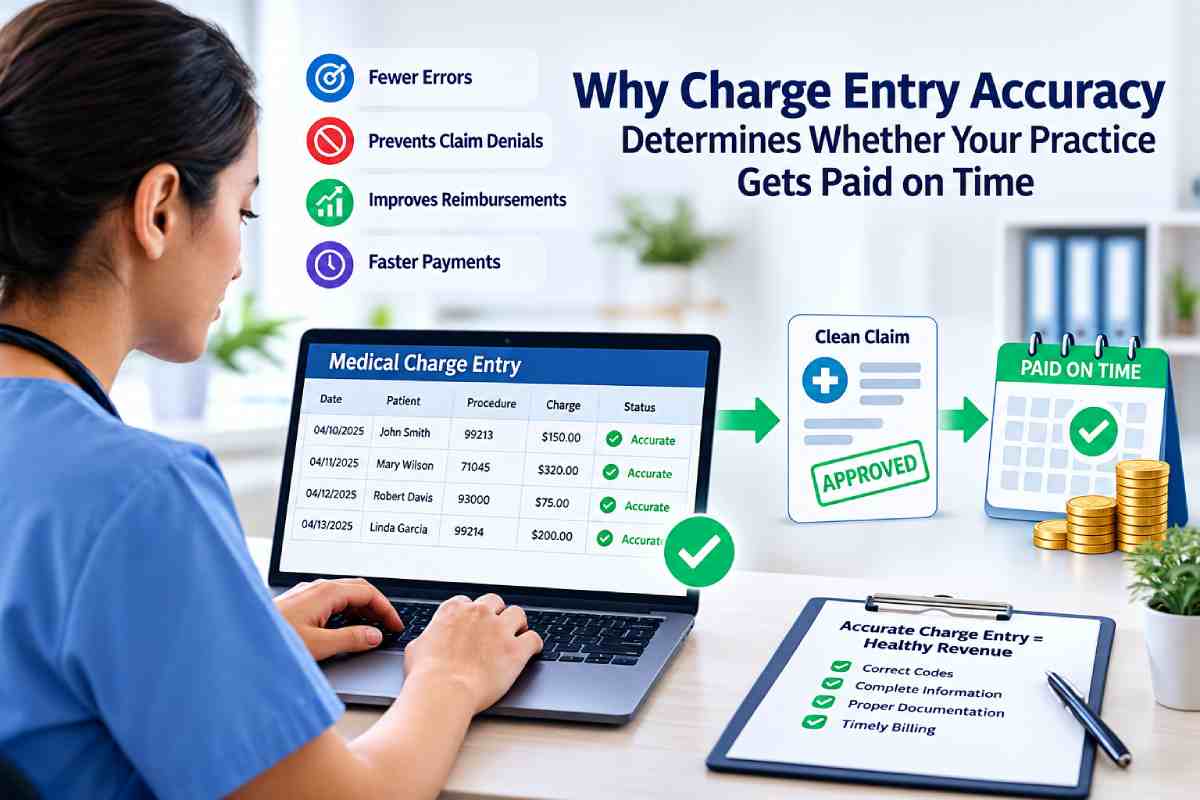
A practice can deliver excellent patient care and still bleed revenue if the charge entry step is treated as an afterthought. This is the stage where clinical services get translated into billable codes and dollar amounts, and even small errors here ripple outward into denied claims, delayed reimbursement, and frustrated billing staff chasing corrections weeks later. Unlike a clinical mistake that might be caught during a visit, a charge entry mistake often goes unnoticed until a claim bounces back from the payer, by which point the cost of fixing it has multiplied. Practices that underestimate this step tend to assume billing problems start with coding or payer rules, when in reality many issues begin earlier, with how charges are captured and entered in the first place.
Charge entry sits at the intersection of clinical documentation and financial operations, which makes it uniquely vulnerable to breakdowns in communication. A physician might document a procedure thoroughly, but if that detail doesn’t translate cleanly into the billing system, the charge can be incomplete, duplicated, or missing entirely. The process involves verifying patient demographics, matching services to the correct codes, confirming units and modifiers, and applying the right fee schedule before a claim is even generated. None of these steps are glamorous, but skipping or rushing any one of them tends to produce claims that require rework, and rework is where revenue cycle timelines stretch from days into weeks.
Where Charge Entry Breaks Down in Daily Practice
In most practices, the gap between documented care and accurate charges comes down to workflow design rather than staff competence. Providers are focused on patients, not billing codes, and the handoff between clinical notes and the billing team is where details get lost if the systems aren’t built to carry that information cleanly. A note that says a visit included an extended counseling session, for example, needs to translate into time-based coding, but that only happens if the charge entry process is structured to catch it rather than rely on someone remembering to flag it manually.
This is part of why practices increasingly look at clinical notes and EHR integrations as a way to close that gap between what was documented and what gets billed. When clinical documentation and the billing workflow are connected rather than operating as separate systems, charge capture becomes less dependent on manual transcription and more aligned with what actually happened during the encounter. That alignment matters most in high-volume settings, such as hospitalist or urgent care practices, where dozens of encounters per day leave little room for someone to manually reconcile notes against charges without something slipping through.
Payer scrutiny adds another layer of pressure to get charge entry right the first time. Claims with inconsistent coding or missing documentation support are more likely to trigger audits or requests for additional records, which slows payment even further. The CMS billing education materials outline many of the documentation and coding standards that charge entry staff need to apply consistently, and practices that build their internal training around those standards tend to see fewer claim rejections tied to avoidable errors. Staying current with those guidelines isn’t a one-time task, since coding rules and documentation requirements shift periodically and a process that worked last year may no longer hold up under this year’s payer edits.
None of this means a practice needs a massive overhaul to see improvement. Often the more realistic fix is tightening the specific points where information changes hands, whether that’s between provider and coder or between coder and billing software. Small adjustments, like standardizing how certain visit types are documented or flagging high-risk codes for a second review before submission, can reduce denials without requiring new staff or systems. The practices that manage charge entry well tend to treat it as an ongoing discipline rather than a box to check, revisiting their process periodically as volume grows or payer requirements change.