
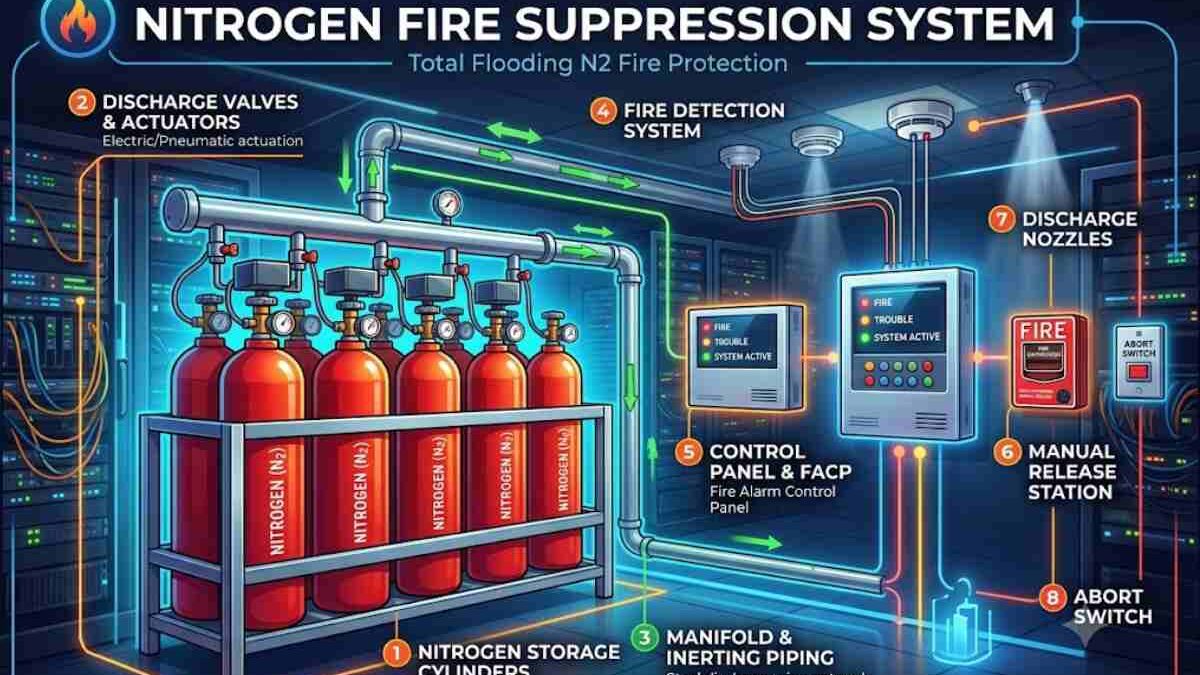
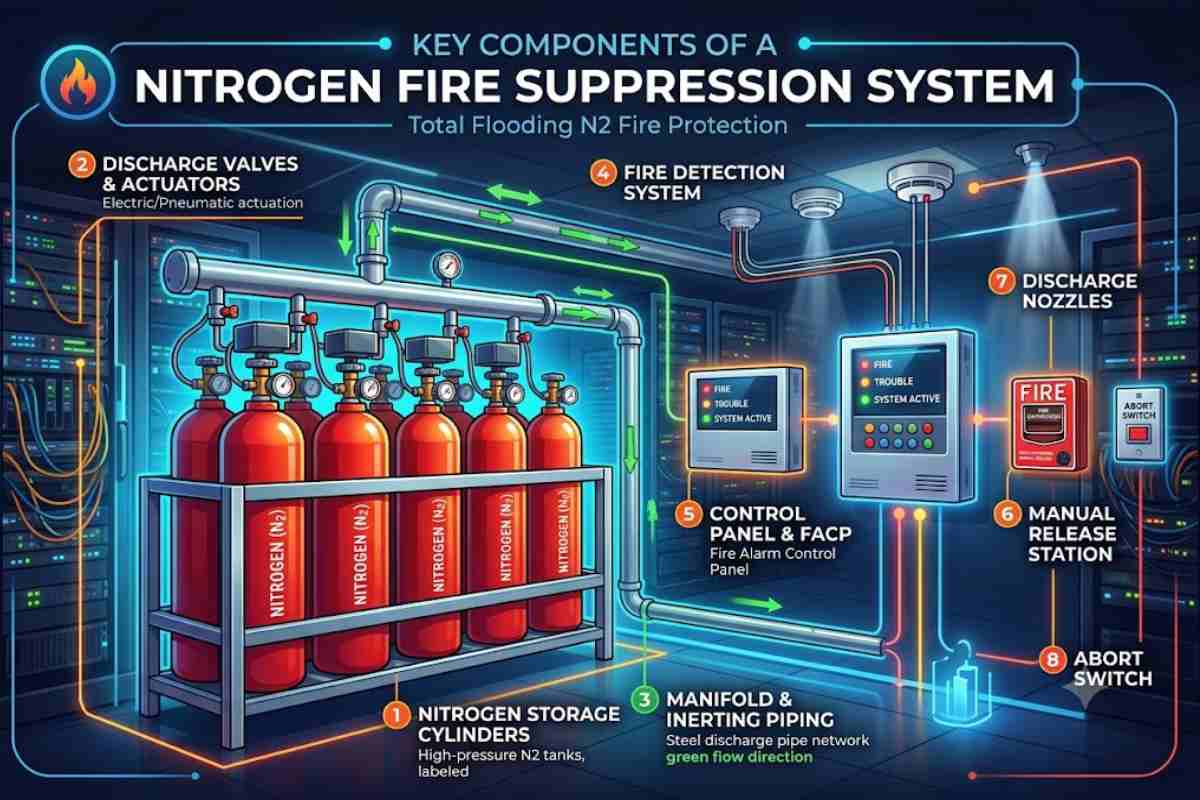
Facilities containing servers, electrical equipment, archives or valuable machinery require fire protection that does not cause water or chemical damage. Understanding the Components of a nitrogen fire suppression system helps facility managers assess how detection, gas storage and controlled discharge work together.
Nitrogen suppresses combustion by reducing the oxygen concentration inside an enclosed space. Because it is electrically non-conductive and leaves no residue, it is suitable for locations where conventional water-based extinguishing could damage equipment or stored materials.
Table of Contents
Nitrogen supply and storage
The nitrogen supply is the foundation of the system. Depending on the installation, nitrogen may be stored in high-pressure cylinders or produced on site and held in suitable buffer vessels.
The available volume must be sufficient to reach the required design concentration throughout the protected enclosure. Engineers calculate this volume using the room dimensions, leakage rate, operating pressure and fire risk.
Systems that rely on on-site generation may also include compressors, air treatment equipment and nitrogen generators. Storage capacity remains important when a large quantity of gas must be released within a short period.
Fire detection equipment
A nitrogen system requires reliable fire detection before gas can be discharged. Smoke detectors, heat detectors or aspirating smoke detection systems continuously monitor the protected area.
Aspirating systems can identify very small smoke particles at an early stage. This makes them useful in data centres, automated warehouses and technical rooms where early intervention is important.
The detection system sends a signal to the central control panel. To reduce the risk of accidental discharge, the installation may require confirmation from more than one detector or detection zone.
Control panel and release mechanism
The control panel processes signals from the fire detectors and manages the release sequence. It can activate audible and visual alarms, stop ventilation equipment, close dampers and initiate the nitrogen discharge.
A short time delay is often included before release. This gives personnel an opportunity to leave the protected area. Systems may also have manual release controls and an emergency abort function, depending on the applicable design requirements.
The control panel should continuously monitor faults in the detection circuits, valves and power supply. Backup power is usually required to keep essential functions operational during an electrical failure.
Pipes, valves and discharge nozzles
A network of pipes transports nitrogen from the storage system to the protected room. The pipe diameter, routing and pressure rating must support the calculated gas flow.
Valves control when nitrogen enters the distribution network. Discharge nozzles then spread the gas throughout the enclosure. Their position and flow characteristics affect how evenly the nitrogen mixes with the room atmosphere.
Incorrect nozzle placement can create uneven gas concentrations or excessive noise and pressure. The complete distribution system must therefore be hydraulically calculated for the specific installation.
Enclosure integrity and pressure relief
Total flooding only works when the protected enclosure can retain the extinguishing concentration for the required period. Gaps around doors, cable penetrations and ventilation ducts can allow nitrogen to escape and oxygen to enter.
An enclosure integrity test can identify leakage before commissioning. Doors, dampers and other openings may need automatic closing systems.
Releasing a large volume of gas can also change the pressure inside the room. Pressure relief vents protect walls, ceilings, doors and windows against excessive positive or negative pressure.
Monitoring and personnel safety
Nitrogen is not toxic, but it displaces oxygen and cannot be detected by smell or sight. The installation therefore requires clear warning signals, controlled access and appropriate operating procedures.
Oxygen sensors may be used to monitor the atmosphere during and after a discharge. Ventilation must restore safe conditions before personnel re-enter the room.
The international standard ISO 14520-1:2023 covers the design, installation, testing, maintenance and safety of gaseous total-flooding fire-extinguishing systems. Applying the relevant standard and local regulations is essential when determining design concentrations, alarms and evacuation procedures.
Fire suppression versus continuous prevention
A total-flooding system releases nitrogen after a fire has been detected. A related approach is an oxygen reduction system, which continuously maintains a reduced oxygen concentration to limit ignition or fire development.
These approaches require different storage capacities, controls and operating procedures. The correct solution depends on room occupancy, stored materials, enclosure integrity and the required level of protection.
A reliable installation combines correctly sized gas capacity with fast detection, controlled release, effective distribution and continuous system monitoring. Each component must be designed as part of one integrated fire safety concept.