
Most businesses don’t realize how much reactive IT costs them until they sit down and actually calculate it. Not the invoice from the last emergency fix — that’s the visible cost. The real cost is the hours of productivity lost, the deals that stalled while a system was down, the employees who worked around broken tools for weeks before anyone flagged it, and the quiet erosion of confidence in the company’s ability to operate reliably.
Reactive IT support feels manageable until it doesn’t. And by the time it clearly isn’t, the damage is usually already done.
Table of Contents
Why Reactive IT Creates Long-Term Problems
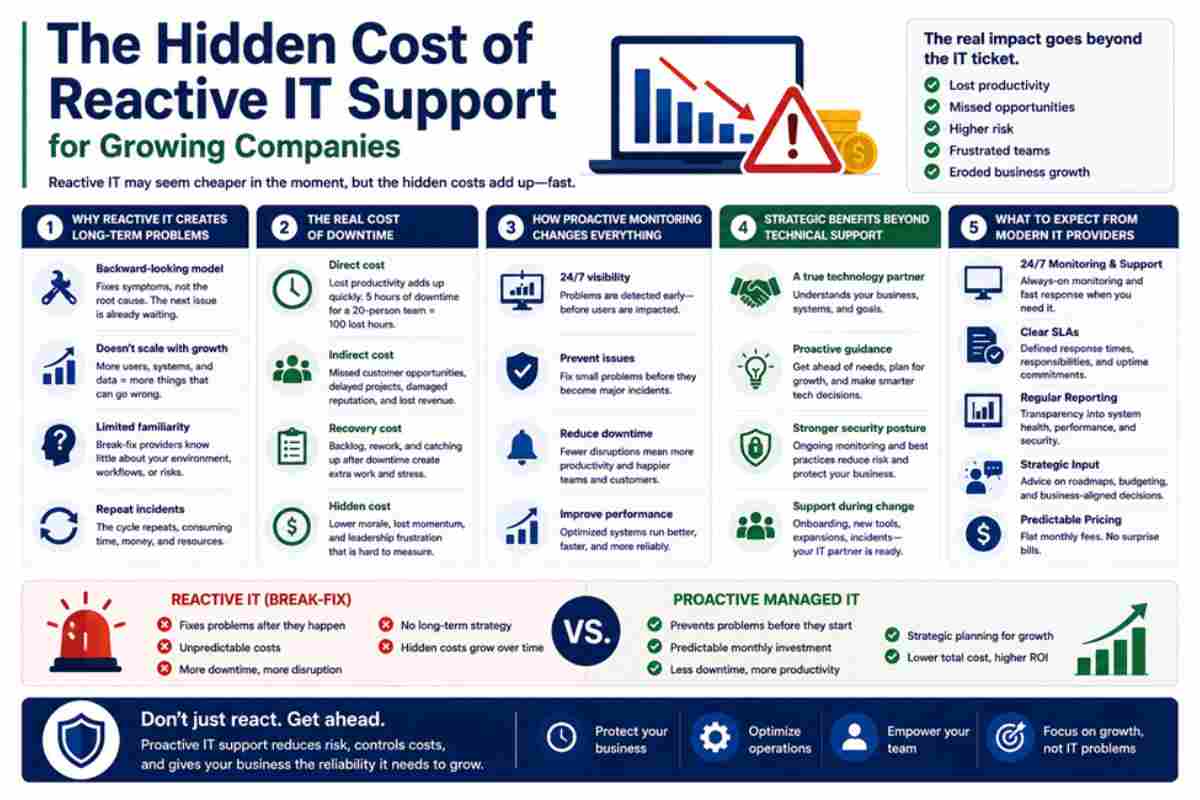
The break-fix model of IT support has a fundamental structural problem: it’s entirely backward-looking. A technician shows up after something fails. They fix the thing that broke. They leave. The underlying conditions that caused the failure often remain untouched, ready to produce the next incident.
This creates a pattern that’s particularly punishing for growing companies. As the business scales — more employees, more software, more data, more complexity — the number of things that can go wrong scales with it. A reactive model can just barely keep pace with the failure rate of a stable, small organization. It cannot keep pace with a growing one.
There’s also the question of institutional knowledge. A reactive IT provider who shows up every few months to fix something knows very little about your environment. They’re not building familiarity with your systems, your team’s workflows, or your business’s specific vulnerabilities. Every visit is essentially starting from scratch.
The Real Cost of Downtime
Downtime has a direct cost and an indirect cost, and most businesses only ever see the direct one.
The direct cost is obvious: the hours your team can’t work because a system is unavailable. Depending on the size of the team and the criticality of the system, this can be significant. A five-hour outage affecting a twenty-person team is 100 hours of lost productivity in a single event.
The indirect costs are harder to measure but often larger. Customers who can’t reach you during an outage. Transactions that don’t happen. Deadlines that get missed. The impression your organization leaves when it can’t deliver on a commitment because of a technical failure.
Then there’s the recovery cost — not just restoring the system, but catching up on everything that piled up while it was down. The backlog after an outage doesn’t disappear when the system comes back online. It just becomes a different kind of problem.
Businesses increasingly rely on professional managed it solutions calgary providers to reduce downtime and improve operational efficiency, specifically because the math on prevention versus recovery almost always favors prevention.
How Proactive Monitoring Changes Everything
The shift from reactive to proactive IT support isn’t just philosophical — it changes what’s technically possible.
A managed IT provider with proper monitoring tools has visibility into your environment that a break-fix provider simply doesn’t have. They can see when a server’s disk space is trending toward full before it causes a failure. They can detect unusual network traffic patterns that might indicate a security incident. They can identify software that’s approaching end-of-life before it becomes a compliance issue.
Most of what makes IT support reactive is the absence of information. Problems exist in the environment, quietly developing, until they cross a threshold visible to users. Monitoring closes that gap. The problem is identified and addressed before it becomes an incident.
This is a fundamentally different operating model. Instead of responding to failures, you’re preventing them. The number of fires drops. The ones that do happen are smaller and contained more quickly.
Strategic Benefits Beyond Technical Support
A managed IT relationship, done well, is more than technical support. It’s an ongoing advisory relationship.
A good managed IT provider learns your business. They know which systems are most critical to your operations. They know your growth plans and can flag when your current infrastructure will stop being sufficient. They’re thinking about your technology roadmap, not just today’s helpdesk queue.
This matters most during periods of change — when you’re onboarding new staff, adopting new software, opening a new location, or navigating a security incident. A provider who knows your environment can respond faster and advise more intelligently than one who has to learn it under pressure.
For growing companies, this advisory function is often as valuable as the technical support itself. Technology decisions made without strategic context tend to create technical debt. A managed IT partner helps you avoid building problems into your infrastructure before they’re built.
What Businesses Should Expect From Modern IT Providers
The bar for managed IT services has risen. The baseline expectation should be 24/7 monitoring, a defined service level agreement, regular reporting on your environment’s health, and documented processes for incident response.
Beyond the basics, look for a provider who is proactive about communication — not just when something breaks, but when something is trending in a direction you should know about. Look for strategic input on technology decisions, not just technical execution. And look for a clear process for planning, so you’re not making infrastructure decisions reactively.
Pricing transparency matters too. Managed IT should come with predictable monthly costs that let you plan and budget. The unpredictable expense of break-fix support is itself a cost — not just financially, but in the planning cycles it disrupts.
Reactive IT support is comfortable to choose because it feels low-commitment. You pay for what you use. No ongoing relationship required. But the cost of that flexibility shows up elsewhere — in downtime, in security exposure, in infrastructure decisions made without strategic context, and in the compound effect of problems that were never really resolved.
The businesses that build the most operational stability treat IT as a managed function, not an emergency service. The ones still calling for help after something breaks are playing a more expensive game than they realize.